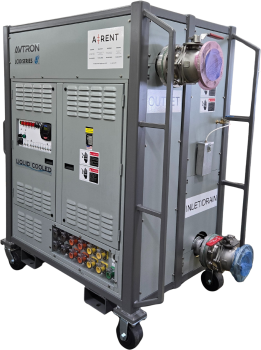
Avtron LC20
Details
720kW Liquid Cooled Load Bank
- Purpose-built for commissioning of direct-to-chip cooling systems and CDUs
- RxMS networking capability for up to 250 liquid or air cooled load banks
- Complies with NEMA, NEC, and ANSI standards
- Ships in durable OEM transport cage
- Four inch 150 lb flange and Tri-Clamp sanitary fluid flow connections with accessory flow manifold and hose options available
- Available to rent or lease
Product Specifications
Capacity Rating: 720kW at 480V and 540kW at 415V
Load Step Resolution: 5kW
Minimum Flow: 60 GPM
Maximum Flow: 300 GPM
Working Pressure Rating: 70 PSI
Maximum Water Outlet Temperature: 180°F
Maximum Temperature Change (ΔT): 85°F
Pressure, Temperature, and Flow Rate Sensors
Description
In modern AI data centers, direct-to-chip cooling is provided by a Technology Cooling System (TCS). Also referred to as “tech water”, the TCS is a closed-loop circuit that delivers coolant to servers and returns it after absorbing heat. The Coolant Distribution Unit (CDU) drives that loop by circulating coolant through the TCS, controlling flow and pressure, and transferring heat to the facility chilled water system through an internal heat exchanger.
These hydronic systems are only proven once they’re tested under a controlled thermal load through a process called commissioning. Commissioning teams focus on the ability of CDUs to maintain a temperature change (ΔT) as load is increased. Liquid cooled load banks introduce that controlled thermal load by applying heat and transferring it into the coolant, allowing the CDU, controls, and cooling loop to mirror operational conditions.
The Avtron LC20 liquid cooled load bank is built for TCS and CDU testing and commissioning, providing a stable, repeatable load in precise steps so system response can be observed and validated under real conditions. To ensure reliability in the field, every load bank from A-Rent is functionally tested, flushed, DI circulated, dried, and sealed before each rental so it arrives clean and project ready.
Additional load bank equipment and accessories, including tap boxes, power cabling, hoses, manifolds, networking, and AC load banks are available for rent. Field technician support is also available to support onsite deployment so the systems can be commissioned as designed.
FAQs
What is a liquid cooled load bank and why is it required for CDU commissioning?
A liquid cooled load bank converts electrical energy into heat and transfers it directly into the fluid loop. In CDU commissioning, this allows teams to simulate the thermal load that servers will eventually introduce. Unlike air cooled methods, this approach validates the full system including CDU performance, pump response, flow distribution, and temperature rise under controlled conditions.
What kind of system behavior can you validate with a liquid cooled load bank?
Using a liquid cooled load bank allows commissioning teams to observe:
- Temperature rise (ΔT) under stepped load
- CDU control response and heat exchanger performance
- Flow distribution across loops
- Pressure stability during load changes
Because the load is applied in controlled increments, the system can be tested progressively rather than all at once. A-Rent ensures each load bank arrives fully tested so these responses reflect the system performance, not variability in the rental equipment.
When are liquid cooled load banks used during a data center project?
Liquid cooled load banks are most commonly used during the commissioning phase, before server cabinets are installed. They may also be used for system validation after modifications, troubleshooting, or performance verification. Because load banks simulate real operating conditions, they provide a controlled way to confirm system readiness before live loads are introduced.
How do you connect the LC20 liquid cooled load bank to a TCS loop?
The LC20 is typically connected into the Technology Cooling System at either the CDU, at test taps, or directly at server tap connections. The configuration depends on how the system is being commissioned, whether validating a single CDU or distributing load across multiple headers. A-Rent supports these configurations by providing the appropriate hose assemblies, manifold options, and connection adapters to match the site’s specific infrastructure, ensuring the load bank integrates cleanly into the loop. Connection types include flange, Camlock, Tri-Clamp, and Danfoss in a range of sizes.
How do you power the LC20 liquid cooled load bank on a job site?
The LC20 is powered through standard load bank connections, typically using tap boxes or direct pigtail connections feeding 4/0 cable sets sized to the required load. The connection method depends on the available power source and how the site is configured. Tap boxes by Starline, Eaton, or Vertiv, are commonly used when connecting to busway systems, while pigtails may be used for direct connection to switchgear or temporary power sources. A-Rent provides the required cabling, tap boxes, and connection hardware to match the application, ensuring the load bank can be powered safely and integrated into the overall commissioning setup.
Can you use multiple load banks together for large data center systems?
Yes. Liquid cooled load banks are commonly networked together to simulate larger system loads, including full CDU capacity or multi-megawatt commissioning scenarios. Systems using RxMS controls can coordinate up to 250 liquid or air cooled load banks within a single network, allowing load to be applied and managed as a unified system. A-Rent provides not only the load banks, but also the networking hardware and controls required to coordinate multiple units, allowing them to operate together during testing as intended.
Can you use liquid cooled load banks with air cooled load banks?
Yes. The LC20 can be used alongside air cooled load banks as part of a combined testing approach. Liquid cooled load banks are used to validate CDU and TCS performance by introducing heat directly into the fluid loop, while air cooled load banks can be used in parallel to apply additional load to the HVAC system. In larger commissioning scenarios, both liquid and air cooled load banks may be staged together to meet total load requirements across mechanical and electrical systems. A-Rent maintains a fleet of air cooled load banks from Avtron, including the 500kW Avtron 2805, allowing both load types to be deployed together as part of a coordinated test setup.
What accessories do you need to run the LC20 liquid cooled load bank?
Successful commissioning requires more than the load bank itself. Typical setups include:
- Power connection equipment such as tap boxes or direct cable connections
- Fluid handling components such as hoses, manifolds, and adapters
- Networking and control hardware for single or multi-unit operation
A-Rent provides these components individually and as a part of the rental package, aligning them to the specific site configuration so the equipment can be installed and operated without modification.
Is technical support available during data center commissioning?
Yes. A-Rent offers engineer-led support with OEM-trained technicians who understand both the equipment and how it functions within CDU and TCS systems. Support can include assistance with setup, connection strategy, load sequencing, and troubleshooting. This is particularly valuable on complex projects where multiple systems including electrical, mechanical, and controls are interacting during commissioning.
How do you ensure the liquid cooled load bank does not contaminate the cooling loop?
Closed-loop systems rely on controlled water quality. Introducing contaminants during commissioning can lead to long-term issues with heat transfer and system reliability. After every rental, A-Rent performs a defined cleaning process that includes flushing the tank, circulating DI water, verifying conductivity, drying the system, and sealing all connections before shipment. This ensures the unit can be introduced into the loop without impacting fluid quality.
Can you run the LC20 liquid cooled load bank with propylene glycol (PG-25)?
Yes. A-Rent units have stainless steel internals that are compatible with both typical glycol blends and pure water.